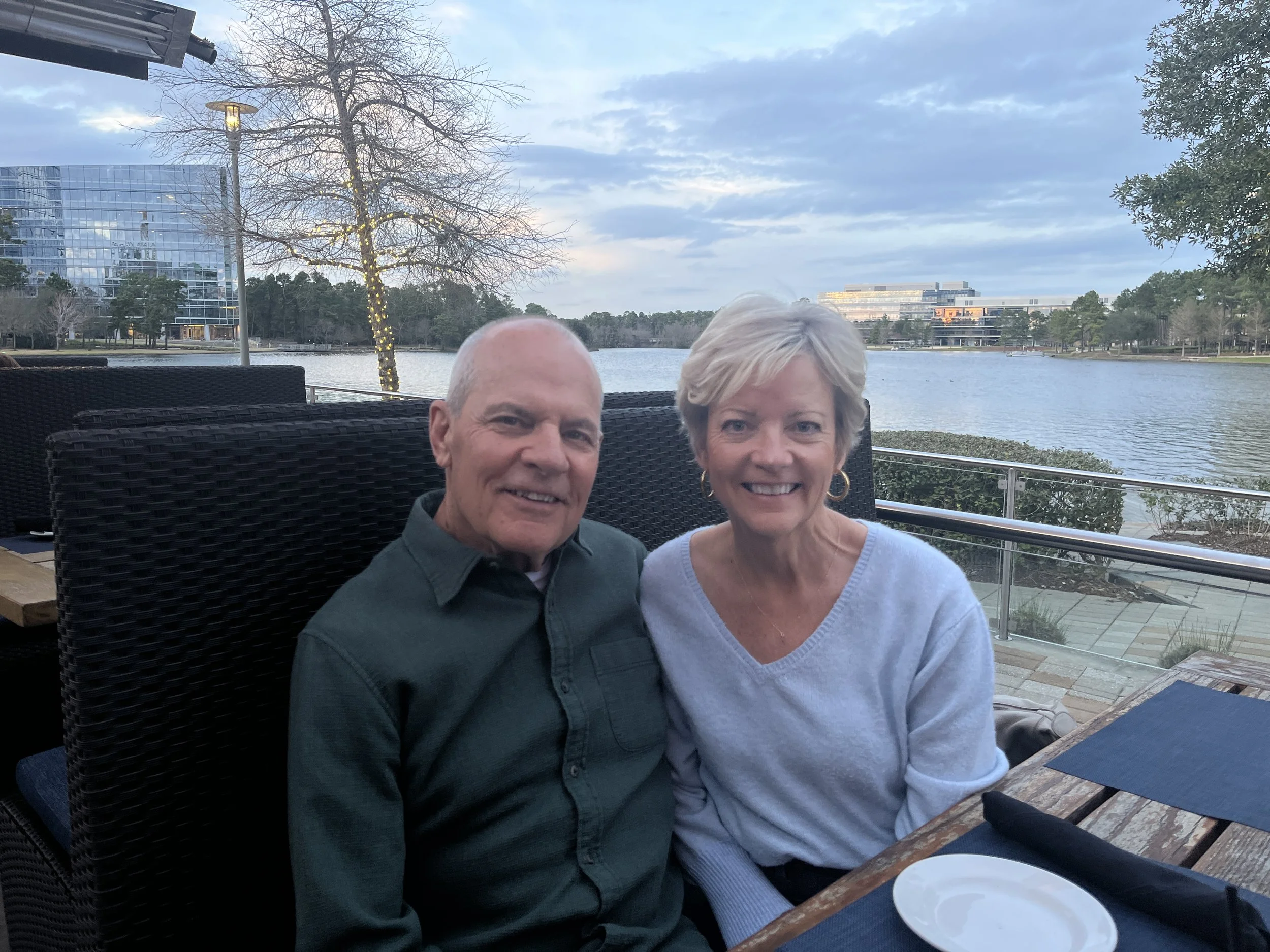
We're Janet and Doug Newberry.
John 15 Academy began with a calling: to restore the lost art of being family. The Story Expedition is taking us deeper into that calling.
Being family is more than a structure or a set of practices. It's a way of being with people—receiving rather than managing, belonging without performance, telling the truth without threatening relationship, allowing need without calling it deficiency, contributing without earning our place, and repairing without exile.
This isn't a gentler way to manage the same life. It's a different life—one that begins with God as our Source.
We've followed our calling upstream—and found the world in which being family becomes possible.
What if flourishing is not something we manufacture?
For years, we have been curious about human flourishing—in families, classrooms, organizations, relationships, bodies, and ordinary life.
Along the way, we began noticing something.
Again and again, the things that support life were not things we invented.
Food. Rest. Movement. Relationship. Belonging. Beauty. Truth. Repair. Purpose. Contribution. Play. The presence of another person who stays.
They were already here.
What if life is already being given?
What if we are living in a world God has already ordered toward life—and we are free to recognize, receive, steward, and participate in what He is already giving?
That question is changing the way we see almost everything.
Before we rush to label what is happening, fix what seems broken, manage a need, or manufacture an outcome, we are learning to pay attention.
There may be more here than we have been taught to see.
That is where The Story Expedition begins.
We began to see two different stories—two ways of understanding how life works.
Both ways of understanding life can exist in the same family, the same classroom, the same church—even in the same heart.
In one story, life is something we must secure.
There isn’t enough, so I must become enough. We learn to measure, manage, protect, perform, and control. Need starts to look like deficiency. Failure becomes a verdict. Other people become problems to solve—or resources for producing the outcomes we believe we need.
And remarkably, even good things can be recruited into this story.
Love can become a way to produce obedience. Connection can become a technique for changing behavior. Rest can become a strategy for greater productivity. Education can become a way to secure a child's future. Prayer can become a way to get the outcome we want.
The gift is still good.
But what story are we asking it to serve?
In the other story, life is received.
This is the world Jesus announced—a Kingdom at hand, where God is our Source, and we are His children. Being human means we will have needs. We were made to receive, relate, and contribute. Limits tell us the truth. Failure gives us information. We can love without controlling the outcome.
And we are here on purpose.
We can prepare a meal, tend a garden, protect a child's sleep, tell the truth, set a boundary, repair a relationship, teach what we know, make something beautiful, offer our attention, and give what we have received.
These things matter. They are participation in the Father's world, here and now.
We can steward the terrain. We cannot manufacture life or fruit.
How We Help
Long before The Story Expedition, we walked alongside families, schools, churches, and organizations who wanted people to flourish.
We learned a great deal about attachment, relationships, education, health, leadership, and formation. We still carry those gifts with us.
But we have begun asking different questions.
When a parent asks how to get a child to obey, we wonder together what story the family is living in. When a teacher asks how to motivate students, we ask what the classroom is teaching children to believe about themselves as learners.
Helping, we are discovering, is less about producing the right outcome and more about tending what is ours to tend—paying attention, telling the truth, responding to what is needed, and giving what we have received.
Often it begins with a talk, a retreat, or a conversation. Sometimes a family, school, or church invites us to keep walking alongside them.
Sometimes the next step isn't another solution.
Sometimes it's an invitation:
Let's go see.
Questions You May Be Asking
-
Yes. Restoring the lost art of being family is still the heart of our work. We still walk alongside parents and children, and the schools and churches that serve them.
What has grown is how far upstream we're looking. Being family isn't a set of better techniques. It grows out of a whole way of life with God as Source. That's where The Story Expedition is taking us.
-
When we say “the Father’s world,” we mean the Kingdom of God Jesus said is at hand—the reality of life with God as our Source and ourselves as His beloved children.
It is not another place we are trying to reach or a better world we have to create. It is the reality Jesus invites us to receive and participate in, here and now.
We call it the Father’s world because we did not make it, and we are not its Source. And because at the heart of the Kingdom Jesus described is a family: the King is our Father, and we belong.
In the Father’s world, love does not have to be earned, and our worth is not on trial. We are free to receive what God gives, and free to give it away.
We are learning to live as though what Jesus told us about His Father and His Kingdom is actually true.
-
The gospel hasn't changed. We've discovered it's much bigger than we were taught.
Many of us learned that God is our Father, that we are saved by grace, that His love is unconditional, and that one day we will be with Him forever. All of that is true.
But we had missed how much of the good news is about now. Jesus didn't only offer forgiveness and a future in heaven. He announced a Kingdom at hand—life with God as our Source, lived now as His children, here on purpose.
We also began to notice how often we believed one story and lived another. We believed in grace while using fear to motivate. We trusted God as provider while living as though everything depended on us. We told our children their identity was secure in Christ while letting achievement and approval measure their worth.
The Story Expedition is helping us notice that gap—not so we can try harder to be better Christians, but so we can live more freely in the reality Jesus has already given.
We are not adding anything to the gospel. We are learning to see how big it has always been—and what happens when we live there.
-
It's the posture of The Story Expedition—and it began with Jesus.
When two curious followers asked Jesus where He was staying, He didn't hand them an explanation. He said, “Come, and you will see.” (John 1:39)
“Let's go see” is our way of receiving that same invitation. Instead of rushing to explain, label, fix, or defend, we become curious enough to look again—especially at what we've assumed is “just the way things are.”
We ask questions. What are we actually seeing? What story have we been taught to tell about it? Where is life already being given?
Then we risk something small. We tell the truth instead of managing an impression. We stay present instead of rushing to fix. We receive a limit instead of fighting it.
And we pay attention to what happens.
The word “let's” matters too. We aren't experts handing out answers. We're fellow travelers, and we'd rather go together.
“Let's go see” isn't a formula for getting the right outcome. It's an invitation to stay curious enough to be changed by what we see.
-
Yes—deeply. We have received enormous gifts from teachers, counselors, doctors, researchers, pastors, farmers, and parents who learned something worth sharing. We carry some of those gifts ourselves.
Good programs can provide structure. Wise strategies can help us respond to what we see.
But any good gift can serve either story. A strategy can help us love a child well—or become a technique for controlling behavior. Expertise can help us see what we couldn't see alone—or convince us that someone else must hold the answer. A program can offer real support—or quietly teach us that life depends on getting the program right.
The problem isn't expertise. The problem begins when we ask a gift to become the Source.
So we receive good gifts with gratitude, use what is useful, and stay free enough to notice when a tool begins to govern the person it was meant to serve.
-
We come alongside people who are willing to look again.
People often come to us with a problem—a child's behavior, a struggling learner, an exhausted leader, a relationship that keeps getting stuck. We take those seriously. But underneath the problem there is usually a longing: for peace at home, for children who love to learn, for work that gives life instead of draining it.
We bring what we've learned over many years. But we don't arrive assuming we already know what your story means or how it should end.
Instead, we pay attention together—to the story shaping what we see, to what is already being given, and to what is ours to tend. Sometimes a next step becomes visible. We risk it, and notice what happens.
We always begin face-to-face, and we're glad to travel—to a family's kitchen table, a classroom, a church, a conference, or a small retreat of two to twelve people. When a family, school, or church wants to continue, we keep meeting, in person and online.
If you're carrying a question like this, we'd love to hear it.
-
You're already invited.
The Story Expedition isn't a program to complete. It's a way of paying attention—and you can begin right where you are.
Notice something you've always assumed. Ask a different question about it. Risk something small. Then see what happens.
You don't have to explore alone. Read our Field Notes. Listen in on Love Is Fearless. Or pull up a chair at The Table, a monthly gathering where fellow travelers bring questions, stories, and discoveries from the places they actually live.
And when you see something, bring it back. Every traveler's discovery helps the rest of us see.

Contact Janet and Doug
Tell us what you’re noticing, what you’re longing for, or what you’d like to explore together. We’ll be in touch.